Dakshinamurthy Stotram Lyrics in Sanskrit & English With Meaning | Adi Shankaracharya
Read complete Dakshinamurthy Stotram lyrics in Sanskrit with English transliteration, verse-by-verse Hindi भावार्थ and English meaning. The iconic 10-verse Advaita hymn by Adi Shankaracharya.
About Dakshinamurthy Stotram (श्री दक्षिणामूर्ति स्तोत्र परिचय)
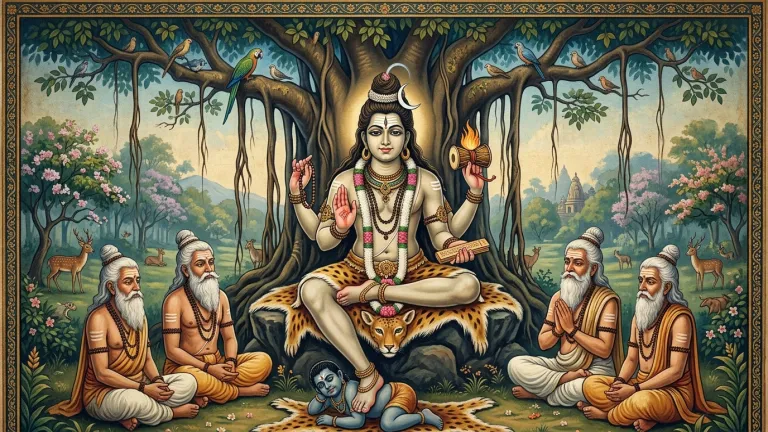
The Dakshinamurthy Stotram (श्रीदक्षिणामूर्तिस्तोत्रम्) is an immortal philosophical hymn composed by Jagadguru Adi Shankaracharya. Addressed to Lord Shiva in His primordial manifestation as Dakshinamurthy—the supreme cosmic Guru who faces South—this 10-verse composition is renowned as one of the most profound condensations of Advaita Vedanta (non-dual philosophy) ever composed.
According to sacred tradition, Lord Shiva sits silently beneath the cosmic banyan tree (Vata Vriksha), displaying the Chin-Mudra (the gesture of pure consciousness where the index finger touches the thumb, symbolizing the oneness of Jivatma and Paramatma). Surrounding Him are ancient Rishis (Sanaka, Sanandana, Sanatana, and Sanatsujata), whose deepest doubts dissolve in the stillness of His divine silence (maunam vyakhyanam).
On this page, devotees and spiritual seekers will find the traditional Dhyana Shlokas and all 10 canonical verses in clean Devanagari script, Roman transliteration, verse-by-verse Hindi भावार्थ, and English translation, accompanied by philosophical insights and meditation practices.
Core Advaita Teachings of the Stotram
Adi Shankaracharya structures each shloka to address foundational tenets of non-dual reality:
The Mirror Analogy (Verse 1)
The phenomenal universe is compared to a city seen inside a mirror. The city appears to have depth and dimension outside, but it actually exists entirely within the mirror. Similarly, the universe exists within the Atman (Self) and is projected outward by Maya.
The Seed and Sprout (Verse 2)
Creation is not the generation of something previously non-existent; it is the projection (srishti) of what was already present in unmanifest potential within the Divine Consciousness.
The Lamp in the Perforated Pot (Verse 4)
The senses and mind possess no independent luminosity; they function only because the inner light of Atman shines through them, just as light streams through apertures in a pot.
The Ashtamurti Doctrine (Verse 9)
Reveals that the five elements (earth, water, fire, wind, space), the sun, moon, and the soul are all manifestations of the one Supreme Reality (Sarvatmatvam).
Spiritual Benefits of Contemplation
According to the tradition of Advaita Vedanta, meditating upon this hymn offers transformative benefits:
- Awakening of Higher Intellect: Enhances memory, spiritual discernment (viveka), and mental clarity.
- Relief from Doubts & Confusion: Dissolves existential confusion and quiets the restless intellectual chatter of the mind.
- Attainment of Guru-Kripa: Serves as an ideal daily prayer for spiritual seekers who seek the guidance of a Satguru or wish to deepen their meditation practice.
- Non-Dual Realization: Verse 10 states that reflecting deeply upon this hymn bestows Sarvatmatva—the direct realization that one's true nature is all-pervading divine Consciousness.
How to Meditate on Dakshinamurthy Stotram
Timing & Orientation
- Ideal Days: Thursday mornings (Guruvar) or daily during Brahma Muhurta.
- Orientation: Sit facing North or East, visualizing Lord Dakshinamurthy facing South.
Meditation Steps
- Chant the Dhyana Shlokas ("Om Namah Pranavarthaya...").
- Hold the hands in Chin-Mudra (index finger touching thumb, other three extended).
- Recite the 10 verses slowly, meditating upon the non-dual meaning of each shloka.
- Conclude with 5 to 10 minutes of silent meditation, resting in the stillness of pure awareness.