Narayana Suktam Lyrics in Sanskrit & English With Meaning | Mahanarayana Upanishad
Read complete Narayana Suktam lyrics in Sanskrit with English transliteration, verse-by-verse Hindi भावार्थ and English meaning. The sublime 12-verse Vedic hymn on the Indwelling Supreme Soul.
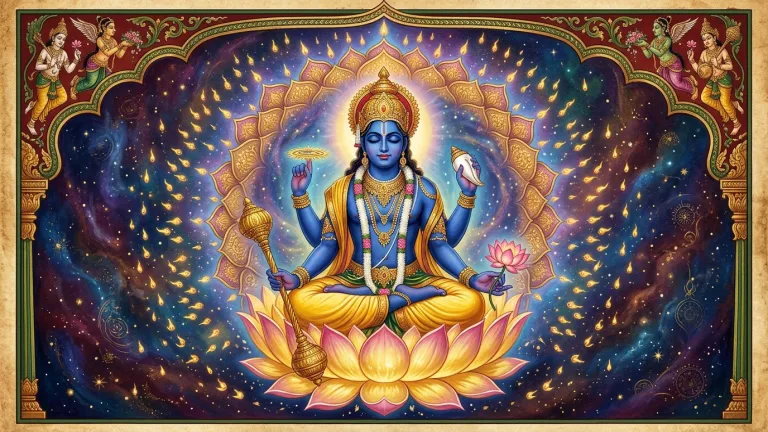
About Narayana Suktam (नारायण सूक्त परिचय)
The Narayana Suktam (नारायण सूक्तम्) is a revered Vedic text found in the Taittiriya Aranyaka of the Krishna Yajurveda, specifically forming the 13th Anuvaka of the celebrated Mahanarayana Upanishad. While the Purusha Suktam reveals the external, cosmic manifestation of the Divine throughout the macroscopic universe, the Narayana Suktam turns inward—providing an extraordinarily precise spiritual map of the Dahara Akasha (the subtle cave of the spiritual heart) where the Supreme Lord resides as the indwelling Witness (Antaryamin).
Comprising 12 profound mantras, the hymn begins by affirming that Lord Narayana is identical with the transcendental Supreme Reality (Parabrahman), the Light of all lights (Paro Jyotih), and the source of all existence. It then guides the meditating yogi from outer breath and physical perception directly into the center of the chest—describing the heart lotus, the subtle flame of consciousness within it, and concluding with the revelation that the indwelling Narayana is Brahma, Shiva, Hari, and Indra.
Spiritual Significance of Narayana Suktam
According to Vedanta and Vaishnava philosophy, meditating upon the Narayana Suktam brings immense spiritual clarity:
Inner Heart Meditation (Daharavidya)
Verses 6 to 12 form the scriptural foundation of Daharavidya in the Upanishads, instructing seekers how to meditate on the golden flame of the Self within the spiritual heart lotus.
Harmonization of All Deities
Verse 12 proclaims: "Sa Brahma sa Shivah sa Harih sa Indrah"—revealing that the one Supreme Paramatman manifests as the Creator (Brahma), the Transformer (Shiva), the Sustainer (Hari), and the King of Gods (Indra).
Dissolution of Fear & Attachment
Knowing that the Lord of the Universe dwells closer to us than our own heartbeat dissolves existential dread, loneliness, and spiritual despondency.
Standard Sandhyavandanam Recitation
In South Indian Smarta and Srivaishnava traditions, the Narayana Suktam is recited daily during midday or evening Sandhyavandanam and during temple Aradhana.
When to Recite Narayana Suktam
-
Morning & Evening Sandhya: Reciting during dawn or dusk transitions aligns the mind with tranquil meditation.
-
Ekadashi Days: Chanting Narayana Suktam alongside Purusha Suktam on Ekadashi yields profound devotional absorption.
-
Before Dhyana / Meditation Sessions: Reading these 12 mantras stills restlessness and naturally draws attention inward to the heart cave.
How to Recite Narayana Suktam (पाठ विधि)
- Posture: Sit upright in Padmasana, Siddhasana, or any comfortable steady posture with spine straight.
- Pranayama: Take three deep, slow breaths to quieten mental fluctuations.
- Heart Contemplation: Bring gentle awareness to the center of the chest (Anahata / Dahara Akasha). Mentally visualize a serene golden flame steady like a lamp in a windless room.
- Sacred Chanting: Recite the 12 mantras with reverence, steady cadence, and attention to the meaning of each line.
- Silent Absorption: After the 12th verse, sit quietly in silence for 2 to 5 minutes resting in the presence of the indwelling Lord.
Frequently Asked Questions (FAQ)
What is the primary theme of Narayana Suktam?
The primary theme is the realization of Lord Narayana as both the all-pervasive cosmic reality (Brahman) and the subtle indwelling Self (Antaryamin) seated within the spiritual heart lotus of every living being.
Where is Narayana Suktam found in Vedic literature?
It is found in the Taittiriya Aranyaka of the Krishna Yajurveda, specifically forming Section (Anuvaka) 13 of the Mahanarayana Upanishad.
What is the difference between Purusha Suktam and Narayana Suktam?
Purusha Suktam envisions the cosmic Divine expanding outwardly as the entire universe, while Narayana Suktam emphasizes internal meditation, describing the subtle flame of divine consciousness residing inside the heart lotus.
Can anyone chant Narayana Suktam?
Yes. Anyone with sincere spiritual aspiration can chant or listen to Narayana Suktam. Devotees often use it as a contemplative prayer before silent meditation.
How many verses are in Narayana Suktam?
The traditional Vedic recension of the Narayana Suktam consists of exactly 12 core mantras.